Crystal Facts · Crystal Learning
Why Labradorite Flashes: The Science of Labradorescence
Why labradorite flashes blue and gold: labradorescence explained, how to see it best, where the stone is found and how to care for it safely.
The Crystal Store · 10 September 2026
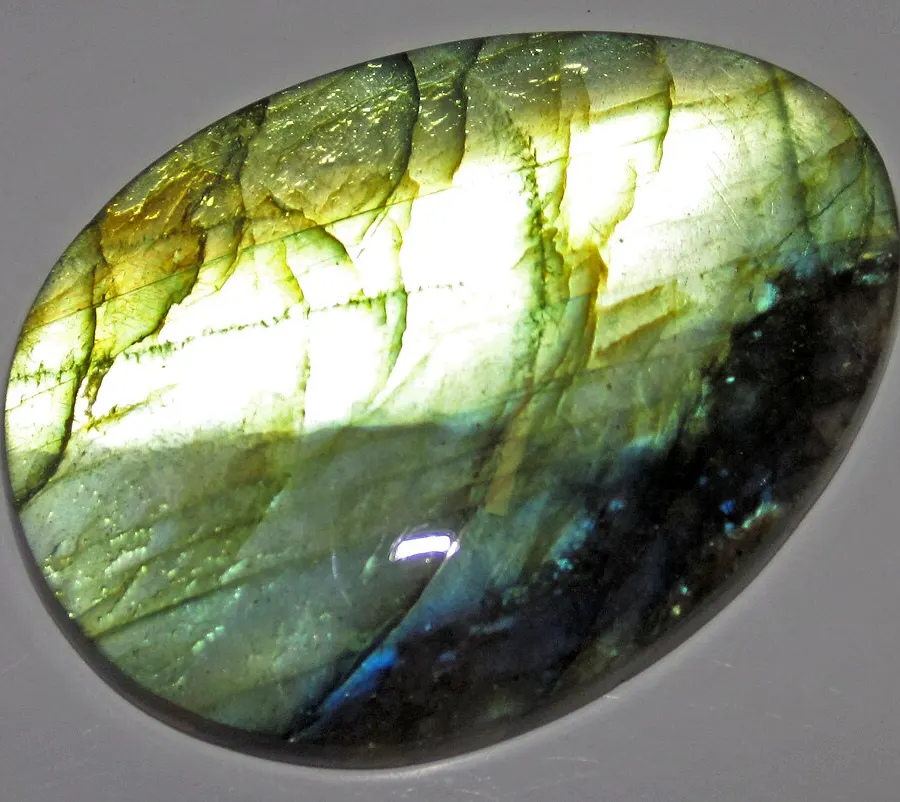
Labradorite flashes because light reflects off thin layers inside the stone, not because of anything on its surface. Turn a piece in your hand and a dull grey can suddenly blaze blue, green or gold. This shimmering effect, called labradorescence, is the reason it’s one of the most captivating stones you can own.
What is labradorite?
Geology.com describes labradorite as a plagioclase feldspar, found mainly in dark igneous rocks such as basalt, gabbro and norite. It’s named after its discovery site near Nain in Labrador, Canada.
Not all labradorite flashes. Geology.com notes that some material from elsewhere, including so-called “Oregon Sunstone”, often lacks the effect, even though it’s the same mineral.
What causes labradorescence?
The colour comes from inside the stone. As Geology.com explains, labradorescence is light reflecting from twinning surfaces within the crystal. These are internal planes where the crystal structure changes direction.
Those reflections are why:
- The flash appears at certain angles. Move the stone, and it can vanish.
- Colours can differ across one piece. The internal structure varies from place to place.
- The surface finish matters. Polishing along the right direction shows it off.
It’s a related cousin of the glow in moonstone. GIA notes that moonstone’s billowing sheen, called adularescence, comes from light scattering between thin alternating layers.
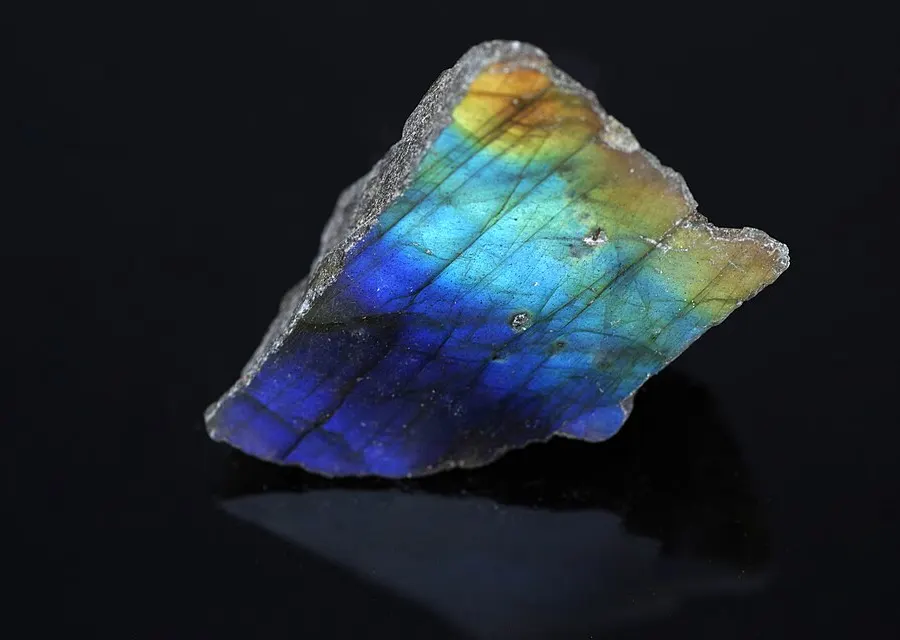
Labradorite at a glance
| Fact | Detail |
|---|---|
| Mineral group | Plagioclase feldspar |
| Hardness | 6 to 6.5 on the Mohs scale |
| Base colour | Often grey to dark grey |
| Flash colours | Blue, green, gold and more |
| Named after | Labrador, Canada |
| Other sources | Finland, Madagascar, Russia and India |
Where labradorite comes from
Finland produces high-quality, strongly coloured material. Geology.com adds that Madagascar and Russia supply grey to black material, with small amounts from India.
What labradorite means in tradition
In modern crystal tradition, labradorite is associated with intuition and transformation, and its sudden flash has inspired plenty of folklore. These are cultural meanings and not proven effects. Our Crystal Guide entry covers it further, along with our page on crystals for intuition.
It’s also a popular stone right now. Crystals.com’s 2026 data places it in its top ten searched stones, although those are one retailer’s figures.
How to see the flash best
- Find a single light source. A window or lamp works better than scattered overhead lighting.
- Hold the stone at eye level.
- Tilt it slowly. Move it until the colour blooms.
- Try different directions. The flash usually shows best along one angle.
- Take photos in the same way. Video shows the effect far better than a still image.
When buying online, look for a video or several photos at different angles. A single perfect photo can’t show you how much of the stone flashes.
How to choose a good piece
- Coverage: how much of the surface flashes?
- Colour range: blue is common, while multiple colours can be more striking.
- Cracks: natural internal lines are normal, but check for open cracks at the edges.
- Your own preference: a bold, patchy flash can have more character than a neat, even one.
How to care for labradorite
Labradorite has two directions of perfect cleavage, so it can break if knocked, even though it’s a fairly hard stone. Geology.com also notes that it scratches more easily than harder gems such as sapphire. So:
- Store it separately, away from quartz and other harder stones.
- Choose protected settings. Pendants and earrings face fewer knocks than rings.
- Clean it gently. Use a soft, damp cloth and dry it straight away. Crystals.com’s water guide advises quick rinses only.
- Avoid harsh cleaners and sudden temperature changes.
Our guides to the Mohs scale and crystals not safe in water go into more detail.
Ways to enjoy labradorite
- On a desk, where daylight can catch the flash during the day.
- As a palm stone, for the pleasure of tilting it in your hand.
- In jewellery, from a pendant to a labradorite bead bracelet.
- As a tumble stone, which is an affordable way to begin.
Labradorite and moonstone in jewellery
Because of their similar hardness, labradorite and moonstone have similar needs. GIA gives moonstone a rating of 6 to 6.5, the same as labradorite. Both show their best effects when cut as smooth, domed cabochons, and both are better suited to pendants and earrings than to rings that get knocked around. Our crystal jewellery guide has more advice on choosing a piece.
Frequently asked questions
Why doesn’t my labradorite flash?
It may need a stronger single light and a different angle. Some pieces also show little or no flash, as it depends on the stone’s internal structure.
Is labradorite the same as moonstone?
No, although both are feldspars with internal light effects. Moonstone typically shows a soft, floating glow, while labradorite shows brighter flashes of colour.
Is labradorite rare?
It isn’t especially rare as a mineral, but pieces with strong, wide colour are more sought after.